
The Battle to Breathe
Season 53 Episode 9 | 53m 34sVideo has Audio Description
Follow the relentless quest that led to a breakthrough treatment for a deadly disease.
Once a death sentence, cystic fibrosis now has an apparent miracle treatment. Follow the decades-long scientific quest, fueled by desperate parents, that led to this breakthrough and ponder the implications for the future of personalized medicine.
See all videos with Audio DescriptionADProblems playing video? | Closed Captioning Feedback
Problems playing video? | Closed Captioning Feedback
National Corporate funding for NOVA is provided by Carlisle Companies. Major funding for NOVA is provided by the NOVA Science Trust and PBS viewers.
Support provided by:


The Battle to Breathe
Season 53 Episode 9 | 53m 34sVideo has Audio Description
Once a death sentence, cystic fibrosis now has an apparent miracle treatment. Follow the decades-long scientific quest, fueled by desperate parents, that led to this breakthrough and ponder the implications for the future of personalized medicine.
See all videos with Audio DescriptionADProblems playing video? | Closed Captioning Feedback
Where to Watch NOVA
NOVA is available to stream on pbs.org and the PBS app.
Buy Now
NOVA Labs
NOVA Labs is a free digital platform that engages teens and lifelong learners in games and interactives that foster authentic scientific exploration. Participants take part in real-world investigations by visualizing, analyzing, and playing with the same data that scientists use.Providing Support for PBS.org
Learn Moreabout PBS online sponsorship♪ ♪ ♪ ♪ JENNIFER TAYLOR: This really is one of the greatest stories in medicine.
Most people thought that can't be done.
NARRATOR: An epic quest... BONNIE RAMSEY: We're gonna keep going.
We're not gonna stop.
We will find something.
NARRATOR: ...to save lives otherwise cut too short.
TAYLOR: It was a sure death, generally in childhood.
NARRATOR: Powered not only by scientists, but by the determination of those with the most to lose.
It was driven by the passion of the parents.
CAM McLOUD: I had to get involved any way that I could.
NARRATOR: An extraordinary scientific breakthrough.
PAUL QUINTON: I ran out in the hallway, "Eureka!"
The most exciting announcement in the 50 years... FRED VAN GOOR: Wow.
This is as clear as science gets.
Not working, working.
SAMYA NASR: I actually cried.
It just blew my mind.
Ah!
NARRATOR: Transforming lives forever.
I'm breathing, like, I'm breathing without pain.
PAUL FLESSNER: It was something you, you sort of dream about.
BIJAL TRIVEDI: To see children starting to recover, It's just... it's just unimaginable.
(deep breaths) NARRATOR: "The Battle to Breathe."
Right now, on "NOVA!"
♪ ♪ ♪ ♪ ♪ ♪ JONATHAN FLESSNER: The fact that I'm running today, with clear lungs and no coughing at all, is something that, when I was born, no one thought would be possible.
I was told kids with this condition are often not living past 18.
It was very scary.
NARRATOR: Jon is out here thanks to a remarkable scientific breakthrough.
JONATHAN: Since the new generation of medications, I can run and never think about being sick at all, it's incredible.
NARRATOR: A revolution in medical science has recently transformed the lives of those like Jon, born with the rare and deadly genetic disease: cystic fibrosis.
JONATHAN: It's a story of hope and perseverance that we've gotten to the place that we're at today.
♪ ♪ (waves lapping) That tiny little guy... PAUL FLESSNER: On May 1, 1989, a miserable kind of snowy spring day a young attending physician walked in, who we'd never met, uh, looked us straight in the eye and said, "Your child has cystic fibrosis.
"They will be sick their entire lifetime "with lung infections, "culminating in pneumonia, "uh, about, uh, age of 18, probably will die."
And that was the diagnosis.
And they, uh, said that we need to immediately test your other son, Andrew, and he was, uh, diagnosed positive the next day.
NARRATOR: Each year, around 1,000 families in the United States are told by their physician that their children have inherited cystic fibrosis-- CF.
TAYLOR: Cystic fibrosis is a genetic disorder.
You have to have one abnormal copy of the gene from your mother, and one abnormal copy of the gene from your father.
So people are born with this disease, they have signs and symptoms early as toddlers, and over time, the disease progresses.
♪ ♪ NARRATOR: Emily Kramer-Golinkoff has lived with CF, against the odds, for 40 years.
KRAMER-GOLINKOFF: I spend a lot of my day hooked up to medical devices.
I inhale a whole variety of different medications.
I have an airway vest, which vibrates my lungs.
There's not a minute of a day that goes by where CF is not on my mind.
There is this like, constant ticker in my head, um, monitoring every single bodily sensation, and it is exhausting.
♪ ♪ NARRATOR: Around 40,000 Americans live with CF, and it affects people of every race and ethnicity around the world.
(din of the city) ♪ ♪ At 25 years old, Marwan Moheissen is one of Egypt's oldest known surviving CF patients.
MOHEISSEN (speaking Arabic): (translated): A lot of people don't know what this is, and I want them to know.
When I'm coughing... (coughing) ...it's not gonna hurt them.
(coughing) It's the opposite.
I'm more at risk.
Leaving home now is harder.
My lungs only work at 30% capacity, and the right lung barely functions.
NARRATOR: For Marwan, and everyone who inherits CF, something that normally protects them turns deadly-- their mucus.
In the normal state, mucus is very thin and watery, so if you inhale something that you're not supposed to inhale, like a particle or a virus, your body helps dispel that by using very thin mucus to get it out.
(coughing) TAYLOR: Whereas in CF, mucus is very thick and sticky, sometimes like tar.
In the lungs, the cilia-- little hairs that usually beat to help you move things out of the airway... in that thick, sticky environment, they can't really function.
So bacteria sets in, and then your body tries to fight off that infection with inflammation, and that makes the mucus even more sticky, so you get into this vicious cycle.
At the same time, you get thick sticky mucus in your pancreas, in your liver, in your gut... And ultimately, it's the damage to the lungs which eventually causes death of most people with cystic fibrosis.
(film reel spooling, seagulls crying) NARRATOR: How we came to understand and break the vicious, destructive cycle of CF is one of the greatest success stories in modern medicine.
It began in New York City in 1938, with an unsung heroine of medical science-- Dorothy Andersen.
TRIVEDI: Dorothy Andersen is amazing.
She was a real character.
I mean, she was a chain smoker, she drank really hard.
And she was a professional doctor when less than 5% of the doctors were women.
In her hospital, there were these children who looked like they were starving and had horrible lung infections but nobody really knew what exactly was killing them.
When Dorothy Andersen did the autopsies, she discovered they had horrible mucus in the lungs, and they had a hard pancreas, filled with glistening white cysts.
The pancreas is supposed to create all the juices that you need to digest your food, but it was dysfunctional.
And so the children couldn't get any nutrition.
When you combined these symptoms, she realized this was a new disease, and she named it cystic fibrosis of the pancreas.
(keys clacking) (typewriter bell dinging) NARRATOR: Dr.
Andersen noted that the majority of patients did not survive beyond a year.
Though CF was new to medical science, one strange symptom of the disease had been described in European folklore for centuries-- "Woe to the child who tastes salty from a kiss on the brow, for he is cursed and soon will die."
KIM CHEEVERS: We did have a pulmonologist who I used to think was so strange, because if kids came in to be ruled out for cystic fibrosis in the hospital, he would actually go and he'd kiss them on the forehead, and he'd be-- he'd come out of the room and be like, "They don't have CF, they're not salty."
(laughs) And I was just like, that is the weirdest thing.
Um, but he was right.
You know, you'd be out in the yard goofing, everybody's sweaty, and you give 'em a kiss.
There it is.
You know, I mean, pungently strong.
There would be salt, you know, on his caps, on his, his face.
And I mean, it was very evident.
QUINTON: My mother was always saying "he's got funny sweat."
(laughing): You know, I don't know if it was so funny, but it was strange.
♪ ♪ (seagulls calling) NARRATOR: For physiologist Paul Quinton, salty sweat would become a vital clue in unravelling the cause of this mysterious disease.
Diagnosed with chronic bronchitis as a baby, by the time he was in college, he'd had part of his lung removed, and he began to research his condition.
QUINTON: There was one book about chronic bronchitis that had this little footnote that said, "see: in reference to cystic fibrosis."
And I-- and the more I read, then I began to get a chill down my back.
"Holy crap, this is me!"
NARRATOR: A doctor confirmed his self-diagnosis.
At 19, he seemed to be living on borrowed time.
CF kids had been living longer thanks to treatments like better antibiotics.
But by 1963, in the U.S., half would still die before the age of ten.
Everybody needs a purpose.
And once I was introduced to this, that gave a purpose, you know-- "what, what is this thing?
"What causes it?
"How does the abnormality in the sweat relate to the abnormalities in the lung?"
NARRATOR: Paul started studying sweat ducts, the tiny tubes that release sweat onto the skin to keep us cool.
Comparing ones from healthy volunteers to his own.
QUINTON: I took biopsies from my thighs.
I would just zap my leg in the, in the thigh and, uh, pull out.
Uh, usually I got maybe four plugs at a time.
If I took my trousers down, we could probably count, but... (laughs) NARRATOR: The plan was to fill a tiny section of sweat duct with salty water, and do electrical measurements on it.
♪ ♪ In everyone, sweat inside the duct contains salt-- sodium chloride-- which, dissolved in water, forms positively charged sodium and negatively charged chloride.
A healthy body wants that salt back, reabsorbing sodium first, which pulls chloride along behind.
That brief separation of charge creates a tiny, detectable voltage.
QUINTON: When I hooked my own up and I got it connected, I looked at the voltmeter, and it kept-- it went well past the normal, and it pegged to the top of the scale.
So I turned it up to the next range, it pegged again.
It made a negative voltage, about ten times higher than it normally was.
And I thought, "Woah!"
What that would really suggest is that the chloride is being held back.
NARRATOR: Paul had realized that the chloride and sodium were being kept apart, driving the voltage higher.
(buzzing) Since chloride and sodium like to be together, sodium also becomes trapped in the CF duct.
And this is why extra salty sweat ends up on the skin.
I ran out in the hallway-- "Eureka!"
(laughing): like some kind of idiot.
But I thought the problem must be chloride impermeability.
Chloride can't get across that, uh, membrane.
And so that's the problem with, with cystic fibrosis.
(shutter click) NARRATOR: Paul published the results of his remarkable self-experimentation in 1983.
"Sweating out cystic fibrosis..." NARRATOR: He'd proved why CF patients have such salty sweat, and chloride was a vital clue in the mystery of what causes the disease.
But turning that knowledge into a life-saving treatment was still a long way off, and would come from an unlikely source.
Back in the 1950s, medicine had very little to offer children with CF.
So, a group of parents, desperate to save their dying kids, felt compelled to act, and formed the Cystic Fibrosis Foundation.
TRIVEDI: These parents knew that little was known about this disease, and unless they figured that out, there would never ever be a cure.
No one was gonna give them the money, they had to do it themselves.
So, over time, they raised it through walks, through bake sales, through galas, and with this money, one of the key things they did was establish care centers.
(deep exhale) (coughing) BONNIE RAMSEY: You know, you would walk down the corridor, you could hear the coughing.
They would actually break their ribs.
Can you imagine the pain of having broken ribs, and yet you have to keep coughing?
NARRATOR: Dr.
Bonnie Ramsey led a specialist CF care center in Seattle, one of a growing network of over 100 funded by the CF Foundation.
RAMSEY: I remember thinking, I can't continue to do this if I don't feel I'm making some sort of difference.
We started looking at nutrition, working on better ways to give the intravenous antibiotics, and then, later, inhaled antibiotics.
I remember one of my patients, and her mom, she said, "We just wanna thank you, "because you've given us our lives back "because, you know, our daughter can be at home sometimes."
(slapping) FLESSNER: Twice a day, we'd put one of the boys on our lap and we'd do these chest percussions, to try to loosen that mucus, so that we keep that infection out of there.
You know, asking "cough, cough, cough it up, cough it up," like all the time.
There was always a cough in this house.
Always.
NARRATOR: Improving treatments helped control the suffocating buildup of mucus and lung infections.
And in the U.S., by 1980, kids with CF finally stood a better chance than not of reaching adulthood.
A lot had happened since the Foundation had been founded.
It was driven by the passion of the parents to raise the money to make the difference.
Progress had been made, but they wanted more.
NARRATOR: The CF Foundation's ultimate goal was a cure.
And in 1980, they recruited Bob Beall from the N.I.H.
to drive that mission forward.
One of my colleagues used to say, "Money buys science, science buys lives."
So first thing that we did is started our research center network.
North Carolina, Alabama, San Francisco, and they all had some research money to be able to explore new ideas.
We were taking shots on goal, and some of them were not gonna pay off.
Some were gonna pay off.
But as Wayne Gretzky says, you miss 100% of the shots you don't take.
NARRATOR: Because of the way CF runs in families, it had to be caused by both parents giving their child a faulty gene.
In the 1980s, "gene hunting" was brand-new to science.
And it was a shot Bob decided to take.
In 1985, Dr.
Francis Collins and his team at the University of Michigan were among those to join the hunt for the CF gene; a formidable challenge.
Talking about the human genome, your own instruction book.
And it has just four letters in its chemical alphabet-- A, C, G, and T-- 3 billion of them and the mistake that might cause cystic fibrosis could be as subtle as one letter gone wrong.
♪ ♪ NARRATOR: Yet, by late 1985, Toronto-based scientist Lap-Chee Tsui had managed to narrow down the hunt to part of our genome called chromosome seven.
Still, there was a vast stretch of DNA to search and, given the task, Francis Collins and Lap-Chee Tsui took the unusual step of merging their labs to collaborate.
COLLINS: My buddy, Lap-Chee.
Ah, this is May of '88, it's a phone call with Lap-Chee.
Big star-- must have thought we had something.
We didn't.
(laughs) That's sort of the way it went.
"It's working."
"No, it's not."
"It's working."
"Oh no, it really isn't."
(laughs) NARRATOR: But then, in spring 1989, they found what they were looking for.
COLLINS: Oh yeah.
Here is the real story.
So this is the way we used to read DNA.
A-T-C-T-T-T-G-G, et cetera.
That's the normal.
This is the same stretch of DNA from somebody with CF.
Again, T-A-T-C-A-T-T-- wait a minute, that's different.
That CTT is missing that you see over here.
CTT is, is, is disappeared.
You're looking at the main cause of cystic fibrosis.
That was the moment that we knew we had something.
♪ ♪ NARRATOR: In around 70% of CF patients tested, these three DNA letters were missing.
The mutation was named Delta F508, and the gene it was found in called CFTR.
NARRATOR: On August 24, 1989, the news broke around the world.
REPORTER (archival): U.S.
and Canadian researchers today announced a breakthrough which could lead to treatment or a cure for cystic fibrosis.
BEALL (archival): The cystic fibrosis gene has indeed been isolated, and the product of that particular gene, the protein, has been identified.
(applause) TRIVEDI: Scientists, the world, the parents, everybody thought, "if we know the gene that causes a disease, we can fix it."
There was a lot of excitement at that point about the concept of gene therapy.
This would be putting a normal copy of the gene into the airways of CF patients, and get things to work normally.
Bob, you know, had this vision, and he came to the board and said, "we need to do this."
And of course, all of us were... totally on board, and we said, "whatever it takes."
(soft chuckle) NARRATOR: At the time, Cam McLoud's son Will was seven years old.
She knew gene therapy might transform his prospects-- and those of all kids with CF.
And within a year, a healthy copy of the CFTR gene was successfully put into cells in the lab.
But doing the same in the lungs of living, breathing people proved much harder.
Your immune system does not like foreign things appearing in your airway.
And so, as hard as we would try to block the immune response, it never got to the point of being efficient enough.
NARRATOR: The CF community had vastly underestimated the challenge of getting their pioneering gene therapy to work.
COLLINS: That was years of effort.
This was not the best time for all of us who had those dreams of saving a lot of lives.
McLOUD: I was devastated when I heard that the gene therapy didn't work, because that was... what we had to look forward to at that time.
TRIVEDI: The parents were full of anger and resentment and frustration, because they were told that this was the way to cure the disease.
"Find the gene, fix the gene, the patient is cured."
But it didn't work ♪ ♪ NARRATOR: In the wake of this setback, one question became increasingly urgent.
If CF scientists couldn't fix the gene, could they instead fix what the gene instructs the body to build-- the CFTR protein.
By 1991, physician Mike Welsh and his research team had demonstrated that this protein forms a pore through the cell membrane.
A channel that allows chloride in and out of cells just like in a healthy sweat duct.
WELSH: So once we knew CFTR was a channel, then we wanted to know, what goes wrong in cystic fibrosis?
Why, why doesn't it work?
And we thought about that, just like an assembly line inside of the cells, lining the airways.
DNA is the code, and the cell takes a copy of the code, then it makes a long string of these little things called amino acids and it folds it up to make the CFTR protein.
And then it travels to the cell surface, where the channel opens to get the chloride moving from one side of the cell membrane to the other.
NARRATOR: Researchers found that many different genetic mutations can cause CF, and that they can break the protein assembly line in different ways.
WELSH: One type of mutation, they never make it.
You never make that assembly line.
And then other mutations, it just doesn't fold right, and it's off the assembly line.
There are also mutations where it folds pretty good, but the channel doesn't open for the chloride to move through.
NARRATOR: Mike's team focused on the folding problem, usually caused by the most common CF gene mutation-- Delta F508.
WELSH: We knew that the F508 protein was misfolded.
And we also knew that folding depends on temperature.
What would happen if you cooled it down?
Maybe that would help the folding problem.
That's what we tried to do.
We cooled it down, it folded more correctly, it went to the cell surface and it didn't work completely well.
It maybe only, only worked a quarter as well or a third as well.
But it worked.
NARRATOR: This was evidence that the most common protein defect in CF patients was repairable in the lab.
So could it be done with a medicine?
No one had used a drug to fix a broken protein in patients before.
♪ ♪ Yet an emerging new technology made it at least plausible.
♪ ♪ (machines whirring) Before screening, we were doing experiments, essentially in test tubes, right.
One at a time, handling it by hand, putting it in a rack.
NARRATOR: In 1998, Paul Negulescu was working for Aurora Biosciences, a small startup trying to accelerate drug discovery using a new technique called high throughput screening.
The idea of high throughput screening is we, rather than handing them all individually, we do the tests in microtiter plates.
We could run tens of thousands in a day, to find just a few chemicals that will potentially do what you want.
NARRATOR: This was exactly what Bob Beall at the CF Foundation had been looking for.
BEALL: We went to them and said we want to screen chemical compounds.
We want to find one or two molecules that might open up the defective chloride channel.
And if they move forward to drugs, that's also very important for us.
NEGULESCU: The idea of fixing a defective protein, that was the part that I think most people thought that can't be done.
You know, nature has made that protein broken.
How can a small molecule fix that?
NARRATOR: Aurora decided to try anyway, proposing a five-year research project.
They would engineer cells to make the broken CFTR protein, and screen hundreds of thousands of chemicals, searching for any that might fix it.
(machine beeping) But it would come at a cost.
We got a price tag of $40 million.
Uh, that was big.
How were we going to find $40 million?
NARRATOR: One family, closely connected to the Foundation, was in a unique position to help.
FLESSNER: I can remember calling Bonnie one day and just saying, "Look, I gotta do something."
Unless there was some dramatic treatment, Paul knew they were going to lose their only two children as young adults.
FLESSNER: I said, I think I might be able to, to get some money.
I made an appointment to go see my boss, a guy named Bill Gates.
And you know, I gave him a story and he said, "Look, Paul.
"you know, I, I want to help you.
"I'm trying to start this foundation.
"The only employee is my dad.
So I need you to go talk to my dad."
So we drove up there and there's the three of us, I think we were in Paul's car.
And that's the most nervous I ever saw Bob.
I'm allergic to cats, and they had cats.
They had cats-- but anyway, we sat around a table.
So we gave the presentation.
FLESSNER: Bill's dad said, "Look, we're "really trying to focus on diseases "in developing countries but "why don't you guys write up a detailed proposal and give it to me and I'll see what I can do."
One day, about two weeks later, uh, the, my, my secretary screams.
I get a call, uh, from Bob Beall, and he said, "Well, my admin just screamed.
"And I went running out to see what was happening, and she was holding up a check."
Sent through the U.S.
Mail for $20 million.
What a, what a day!
NARRATOR: Such a large donation, plus further funds raised, meant the Foundation could strike a ground-breaking deal with Aurora.
BEALL: What resulted was a concept called venture philanthropy.
We were taking philanthropic dollars and becoming venture capitalists.
McLOUD: The Foundation would invest in the riskiest part of the drug development, drug discovery process.
And then if it was successful, there would be a royalty stream.
That was very unusual, because this was the first disease-specific non-profit to use venture philanthropy to try and fund drug development.
Nobody else had ever done that.
This was a huge gamble.
♪ ♪ NARRATOR: With only half of all CF patients in the U.S.
reaching their early 30s, the Foundation judged it to be a risk worth taking.
And by mid-2001, Paul's team, now part of Vertex Pharmaceuticals, was screening thousands of chemical compounds a day.
They were adding them to cells they'd engineered to make the defective CFTR protein, hunting for an elusive "hit."
A chemical that might fix it.
NEGULESCU: This is similar to the setup that we had 20 years ago.
Uh, the robots are a little more reliable.
There's enough screening to keep us busy for years.
The initial screens did not identify any hits that we could optimize.
And so maybe some of the naysayers were right.
Maybe this is an impossible problem.
NARRATOR: The skepticism was well-placed.
After four long years, searching through hundreds of thousands of chemical compounds, they had found just a handful that looked promising.
Looking for chemicals, it's not, it's not easy.
And when you find one that sort of works, you take that molecule and then you have a whole group of chemists.
They'll take an atom off here, add one over here, does the molecule work better?
NARRATOR: This painstaking process finally led to their first candidate drug, named VX-770.
It had worked extremely well in their lab tests, but would have no future unless it also worked in living cells from human tissue.
FRED VAN GOOR: So we're looking at a layer of human lung cells in a dish, and these are from a person with cystic fibrosis.
NARRATOR: Fred Van Goor was one of the few people who could culture these living cells, to look just as they did inside a CF patient's body.
VAN GOOR: You know all these shapes that you're seeing here.
That's that thick, sticky mucus that's just covering the surface.
Yeah, totally covered.
VAN GOOR: And there should be cilia beating, because that's what helps clear out the lungs.
You know, they're trying to beat, but there's not much going on.
NARRATOR: In 2006, Fred tested their new compound on these cells from a CF patient.
NEGULESCU: Fred came up to my office and said, "I think you should see something."
(laughs) VAN GOOR: As I bring this into view... wow.
And look at that.
You no longer see that thick, sticky mucus.
And then the other thing you see is all of this cilia beating.
And that's an indication of, you know, both the mucus is now less thick and there's fluid on top.
And that happens because you've restored the defective CFTR protein.
NEGULESCU: I just thought it was beautiful.
VAN GOOR: Yeah.
This is as clear as science gets, you know?
Not working, working.
♪ ♪ Good news travels fast, and people started lining up to see, you know, that little cell, you know, those little cilia beating.
NARRATOR: It was a glimpse of what VX-770 ought to do, inside patients.
With their CFTR channel working, chloride should reach the airway surface, and draw water with it by osmosis.
That should thin the mucus, so the cilia beat freely, clearing the lungs to breathe.
(inhaling, exhaling) NEGULESCU: After being used to the general premise in the field that you fail so often, to realize this was going to work was quite a, quite a moment.
(indistinct chatter) NARRATOR: After eight years of work, this was an incredible breakthrough.
But there was a catch.
VX-770 did not correct the most common protein folding problem.
It only addressed a much rarer defect found in just 5% of patients in the U.S.
The question that was asked, do we really want to develop a drug that only works in 5% of our patients?
The, the call that you've gotten a hit, was something you, you sort of dream about.
Then to find out that, you know, probably wasn't gonna help, you know, our boys, it was hard.
And I remember the meeting and they, you know, they're like this is gonna cost at least tens of millions of dollars, possibly much more.
Do we move forward?
And I was quick to say, "Look, we can't not do a treatment."
Uh, uh, you know, it's just unconscionable to sit here and make that decision.
(waves splashing) NARRATOR: Despite the cost, the Foundation decided to proceed.
(birds tweeting) They would raise $175 million to continue their hunt for new drugs and support clinical trials of VX-770.
(children playing) LAURA CHEEVERS (on laptop): My name is Laura Cheevers and I'm 11 years old.
My sister Cate also has CF.
We just signed up for what my mom calls a possible life-changing research study.
NARRATOR: Both of Kim Cheevers' two young daughters, Cate and Laura, had the rare mutation needed to take part in the VX-770 trial.
(coughing) By 2010, she was desperately worried about their increasingly fragile health.
CHEEVERS: You started to feel this sense of urgency, like, okay, now we really need to get going on these trials.
NARRATOR: Both girls would take a pill, twice a day, but because the trials were blinded, Kim had no idea if it was the drug or a placebo.
CHEEVERS: When Laura started, you know, we didn't see too much of a difference.
We kept waiting for this magic moment to happen.
But within a month, you saw a difference in Cate.
Less coughing for sure.
I think she gained seven pounds in six months.
We were kind of like, okay, Cate's on it.
We gotta believe she's on it.
And we really hope that Laura's not on it, because this is not doing anything for her, like, that was probably the scariest time.
NARRATOR: After more than a year in the dark, both girls were officially given VX-770.
LAURA CHEEVERS (on video): Hello, folks, and we are back.
CHEEVERS: Laura went on to the medication and she had the same type of effects that Cate did.
We could see it.
So this was like really, really amazing.
Amazing, and we were very happy.
NARRATOR: The official trial results confirmed VX-770 worked.
NEGULESCU: Lung function improved by about 300 milliliters of air, so that's about a Coke can of air that people were now able to move in and out of their lung in one second, uh, more than they could before.
And people can feel that.
Oh, this was remarkable.
We really had a shot on goal that worked.
NARRATOR: The FDA approved the new drug, marketed as Kalydeco early in 2012.
And for a small number of patients, it was transformative.
But most were still reliant on standard treatments, including Cam McLoud's son, Will.
McLOUD: Will was spending more time in the hospital and was getting weaker.
And he was in the I.C.U.
for a while.
And then they were talking about releasing him to the CF floor.
And, um... that night he passed away.
And, um... ...of course I was there with him.
Um, but, um... ...we, we didn't get the answers for Will in time.
NARRATOR: Will was 34 when he died in 2016.
McLOUD: He lived twice as long as it was projected, you know, is, is something that I would always be grateful for, although, you know, certainly wish he were here right now.
(birds twittering) NARRATOR: The majority of CF patients were still in desperate need of a drug.
And at Vertex, the hunt went on.
Screening over a million chemical compounds to find any that might fix the folding problem caused by the most common mutation, delta F508.
Over seven more long years, they developed two other drugs that offered incremental gains.
But a third led to their most promising treatment yet.
This new drug combined two compounds to help the protein fold correctly.
And it included the original one from Kalydeco, which helps it open properly as well.
More than 20 years after the CF Foundation's most audacious shot on goal, Trikafta was approved for use in the United States in 2019.
Trikafta!
WOMAN: My life is about to change forever.
NARRATOR: Many thousands of patients began taking their new daily drug.
Whoo-hoo!
NARRATOR: Soon experiencing what became known as the purge.
(coughing) Lots of mucus today.
I've been coughing all day.
(coughing) And it's gross.
Where mucus could be coming out of, it was.
Within a few hours, you might start having massive amounts of mucus from your lungs, from your gut, from all parts of your body.
And you're gonna start feeling better in those few hours.
Like, I'm breathing without pain.
It's unreal.
My energy level has been through the roof.
I can breathe in so much deeper.
(exhales) If Kalydeco was a spark, like, Trikafta was like a bonfire.
NARRATOR: For Cate and Laura Cheevers, the effect of Trikafta went far beyond their experience with Kalydeco.
I remember my friend, and he was like, "What happened to your cough?"
(laughs) And I was like, "Okay, well I just started a new treatment."
And he was like, "It's gone?"
And I was like, "I think so."
It's like so funny 'cause I just don't think about it anymore.
At all.
NARRATOR: In the few years Trikafta has been around, average life expectancy for people with CF in the U.S.
has leapt almost 20 years.
JONATHAN: Trikafta changed everything.
You know it gave me hours of myself back every single day.
And to have that amount of freedom physically is incredible, but it's a mental weight that is almost heavier that's been lifted off.
NARRATOR: Since starting Trikafta six years ago, Jon's life is entirely transformed.
ELLIE FLESSNER: Yeah, you love the cheek.
NARRATOR: And his brother Andy's, too.
FLESSNER: The biggest news we have in our family is that we have a grandson and a new granddaughter.
Something that Sue and I had never ever thought about, just didn't consider, wouldn't let your brain go there, uh, is now reality.
JONATHAN: You know, I've talked to the clinic and you know they talk about how many babies they're having nowadays, it's just all the time.
You know, CF parents having babies.
It's pretty unbelievable.
We're lucky, we're lucky.
(chuckles) NARRATOR: And thanks to the new medications, there are even greater hopes for the future.
If treated early enough, people born with the most common CF mutation might soon expect to live a life as long as anyone.
What Vertex and the CF Foundation have achieved together is extraordinary.
But so, too, is the price of the new treatments.
BEALL: Vertex announced that it was gonna be over $300,000 per patient per year.
And that was mindboggling.
You can have great drugs, but unless they're accessible to the community that needs them, they really are not any good.
NARRATOR: Vertex defends its pricing, saying it reflects "more than two decades of work" and "billions of dollars invested in research and development."
PROTESTERS (chanting): Shame on Vertex!
NARRATOR: But critics point to the huge sums U.S.
insurers have to pay out.
PROTESTOR: Vertex, shame on you!
NARRATOR: And that Vertex's prices aren't affordable in many countries around the world.
PROTESTORS (chanting): Every country, every kid!
MOHEISSEN (translated): I heard about Trikafta.
How it's one of the most expensive drugs in the world.
I could work an extra lifetime and still wouldn't be able to afford it!
SAMYA NASR: It doesn't matter if you're poor or rich, you have the right to, to breathe.
NARRATOR: Dr.
Samya Nasr is an American physician, who also works with the CF team at Ain Shams University Hospital in Cairo.
NASR: Life expectancy for CF patients in Egypt is around eight years of age.
I'm seeing the improvement that this drug can give to patients in the U.S., and I wanted that to be here because I'm really tired of coming in, asking about patients, and they already died.
(indistinct chatter) NARRATOR: In 2023, Samya helped persuade Vertex to add Egypt to their pilot donation program, which currently offers Trikafta in a few countries, at no cost.
I actually cried.
The prospect of bringing Trikafta here, it just blew my mind.
(translated): Honestly, you can't believe how happy I am.
NARRATOR: In 2025, Marwan got his prescription.
(translated): Finally guys, we've got it!
It's unbelievable!
(screams) Oh!
NARRATOR: He began the process of pills... ...followed by purge... (coughing) ...and three months later, returned to the hospital to have his progress assessed.
NURSE (speaking Arabic): (exhales) (indistinct chatter) NURSE: 14.
14, okay.
Yes, all the numbers are better.
NARRATOR: Marwan's lung function has doubled.
MOHEISSEN (translated): I'm so happy.
Because there's a huge difference.
This could be a new start for me, to change my life!
NARRATOR: If Trikafta, or a generic equivalent, became accessible worldwide, the lives of more than 90% of people with CF would be transformed.
NARRATOR: But there are still some who will never benefit from such a lifeline.
So this was also that... KRAMER-GOLINKOFF: I've learned over the past decades that, you know, you don't need like, so much hope to keep going.
But you do need these glimmers of hope.
And when those glimmers go away, and it's just darkness, those are the moments that it's really hard to endure.
Yeah.
NARRATOR: Emily is one of around 10% of people with CF who don't benefit from Trikafta.
In her case, she has a rare mutation, which means she makes no CFTR protein for the drug to fix.
She and her family now live in total isolation.
You know, I think it's when I sort of entered the 30% lung function phase that we started to get scared.
To realize that there were no drugs in the pipeline that would help us.
It was really devastating, for us.
♪ ♪ NARRATOR: To hold onto hope, Emily and her family began their own non-profit, Emily's Entourage.
Raising awareness and over $20 million so far in pursuit of solutions for the 10%.
KRAMER-GOLINKOFF: We are looking to advance research for any kind of therapeutic that, um, addresses those that don't benefit from existing treatments.
So it can be gene editing, it can be gene therapy, it can be small molecules.
We need a toolbox of options to address all of the things that we live with, and to get us to one-time cures.
I mean, that is the dream.
BEALL: You have to understand that with the drugs that we have now, we still lose patients.
We're still, sort of, treating the symptoms of CF.
And we would love to be able to give a patient a one-time drug.
And that would be the cure.
NARRATOR: Over the last ten years, the CF Foundation has refocused its efforts, from fixing the CFTR protein, back to trying to fix the gene.
That's possible because its venture philanthropy gamble paid off.
BEALL: Part of venture philanthropy was that we took royalties once the drug was approved.
If it wasn't approved, we didn't get anything back.
NARRATOR: When Kalydeco was approved, its high price and the prospect of more drugs in the pipeline, delivered in 2014 an unexpected windfall.
BEALL: Lo and behold, somebody said, we'll buy all your future royalties.
And they had determined that was worth $3.3 billion.
The reaction that we had sitting around the board was, you know, mouths open.
What could CFF do with $3.3 billion?
We could do a lot.
NARRATOR: As of 2026, the Foundation is supporting development of several new treatments, including a number of different CF gene therapy trials.
TAYLOR: It's incredibly exciting to know that we are back, testing gene therapy, to try to cure CF.
NARRATOR: In Denver, Dr.
Jen Taylor oversees two of these trials.
TAYLOR: We have the technology to see if we can actually at least fix the gene in the lungs of people with cystic fibrosis.
And the thing that's so amazing about these therapies is it wouldn't matter what mutation you have.
If they work, they'll work for all people with CF.
NARRATOR: If the cystic fibrosis community is successful in their quest for a cure, they may once again transform not only CF, but science itself.
Thanks to the determination of parents, patients and scientists, pioneering breakthroughs in genetic medicine may go on to transform life for most people with CF.
And they're not giving up, until there's a solution for everyone.
My tattoo says, "Until it's done."
Because we still have a lot of work to do.
And that is our mission: until it's done.
♪ ♪ ♪ ♪ ♪ ♪
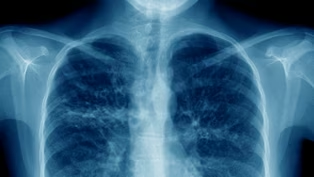
Video has Closed Captions
Preview: S53 Ep9 | 30s | Follow the relentless quest that led to a breakthrough treatment for a deadly disease. (30s)
Providing Support for PBS.org
Learn Moreabout PBS online sponsorship New Episode
 New Episode
- Science and Nature

Miles O'Brien travels the world searching for solutions to today’s most urgent challenges.



 New Episode







Support for PBS provided by:
National Corporate funding for NOVA is provided by Carlisle Companies. Major funding for NOVA is provided by the NOVA Science Trust and PBS viewers.